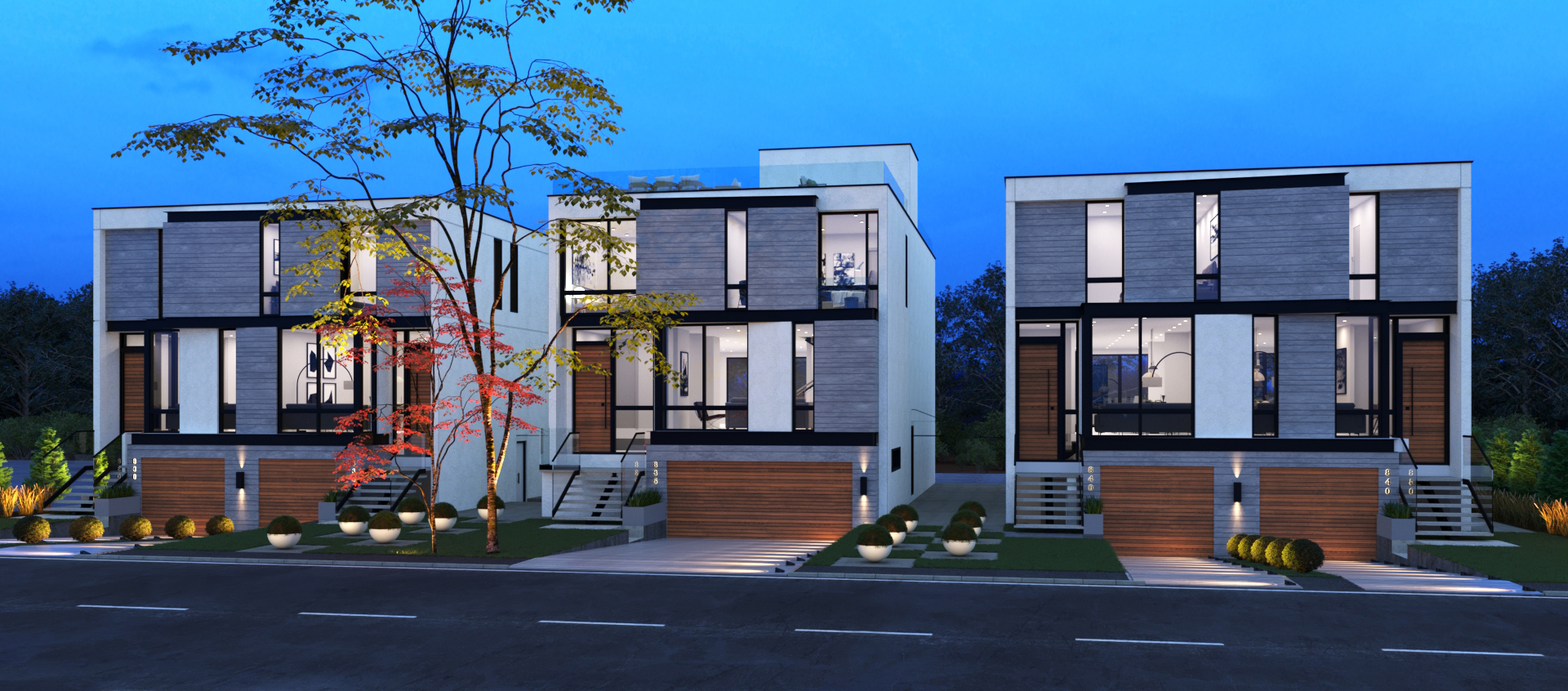
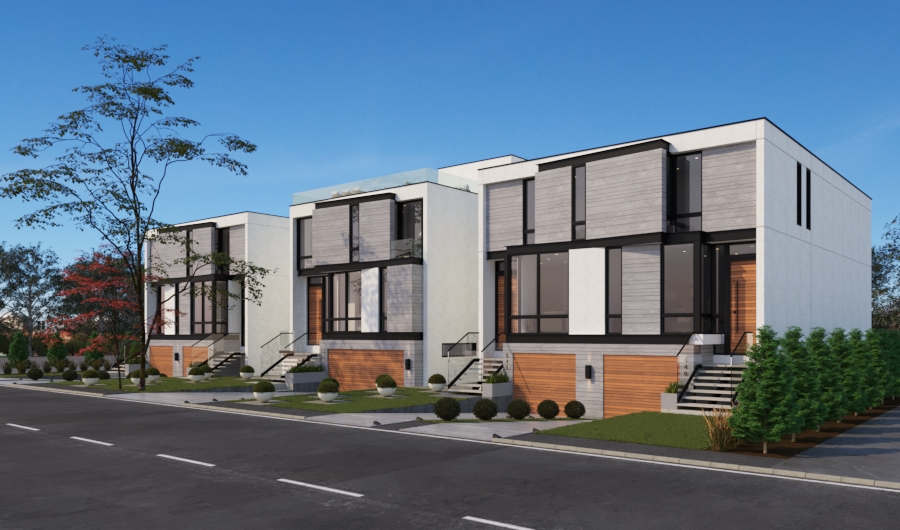
830 Alpine Avenue sits in Britannia Heights, an established Ottawa neighbourhood near the Ottawa River and the Britannia Park waterfront. Quadrant Architects consolidated two original single-family lots, each measuring 65 feet by 110 feet, into a five-lot infill subdivision. The redevelopment includes four semi-detached homes flanking the property and one single-detached home at the centre.
The result reads as four large detached homes from the street rather than four semi-detached pairs. The streetscape is denser than what was there before, but coherent with the surrounding neighbourhood fabric.
The defining design move on this project is at the streetscape. Each pair of semi-detached homes was composed to read as a single large detached residence from the public sidewalk. Aligned rooflines, coordinated window groupings, and shared material finishes across each pair produce a facade rhythm that hides the party wall.
The result is a five-home development that presents to the street as if it were three large homes (two paired compositions plus the central detached). For a neighbourhood with an established character of single-detached homes on wider lots, this is what allows new infill at higher density to belong rather than disrupt.
Each semi-detached pair shares a common design vocabulary while expressing subtle differences in detailing and proportion between the two halves. Buyers see homes that match the character of the neighbourhood. The municipal planning review sees a coherent streetscape proposal. The math of higher density still works.
A significant mature tree sat directly in front of where the central detached home was planned. Removing it would have been the simplest solution but was not consistent with the site’s character or with the City of Ottawa’s tree protection policies for mature canopy trees on infill sites.
The design team chose to preserve the tree and reconfigured the site plan around it. Driveway access, garage placement, and the front yard layout for the central home were all redesigned to keep the tree’s critical root zone undisturbed. Coordination with City staff and consulting arborists confirmed the protection measures during construction.
The cost of preserving the tree is invisible in the finished project. The benefit is also invisible if you don’t know to look for it: a 50-year-old canopy tree in front of a new home in an established Ottawa neighbourhood. Removing mature trees on infill projects is fast and cheap. Keeping them takes design effort and regulatory coordination, and produces a property that ages better.
A 22.5-foot lot frontage is narrow by Ottawa standards. It demands a vertical arrangement of living spaces and careful resolution of the front facade.
The semi-detached homes were designed with a vertical organization that places living spaces above the garage on the main and upper floors. This allowed each unit to incorporate an attached garage on a 22.5-foot lot, which is otherwise difficult to achieve while still providing the main-floor footprint buyers expect. The vertical strategy also let the front facade prioritize fenestration and articulation over driveway and garage door at the street level.
The central detached home, on its 40-foot lot, follows a more conventional two-storey horizontal arrangement appropriate to the wider lot. It anchors the development as the most prominent home on the block and reinforces the streetscape’s overall composition.
An infill subdivision in an established Ottawa neighbourhood triggers Site Plan Approval through the City. The application has to demonstrate compliance with the local zoning bylaw, consistency with the surrounding streetscape, adequate servicing capacity, tree protection (where applicable), and acceptable parking and circulation arrangements.
The Britannia Heights project moved through Site Plan Approval and Building Permit with the architectural control component built into the streetscape design from the start. Showing the City exactly what the five homes would look like, including the streetscape composition and the tree protection strategy, materially shortened the review time compared to applications that ask for approval of a subdivision concept without the design resolved.
This is the discipline that distinguishes infill projects that get approved efficiently from ones that stall. The architectural design and the planning case are not separate exercises. They are the same case, told to two different audiences.
Related work: land development and severance · multiplex housing · residential architect services
Project lead: Sara Rahgozar, M.Arch, OAA. 416-357-5713 · sara@quadrantarchitects.com