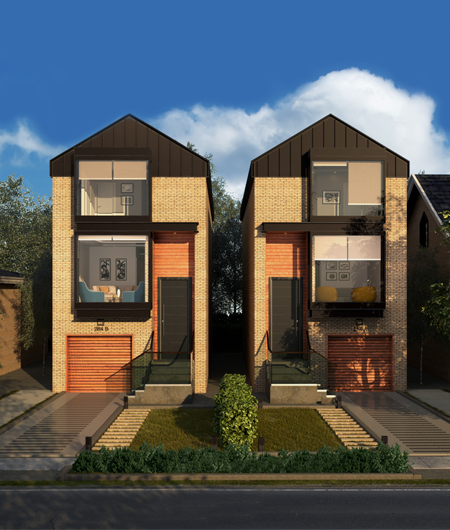
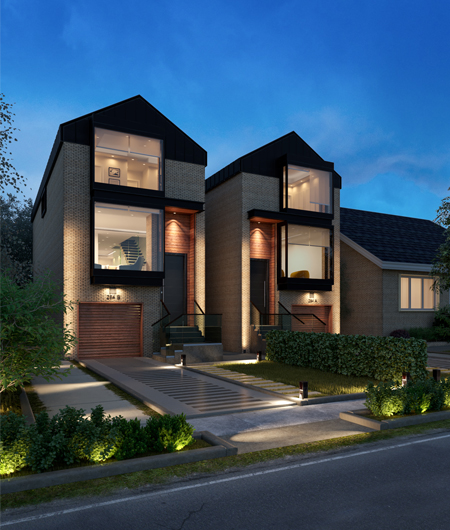
284 Bogert Avenue sits in the heart of North York, a short walk from Sheppard Subway Station and the North York City Centre. The original property measured 50 feet by 120 feet, large enough to support two homes if the Planning Act and the Committee of Adjustment agreed. Quadrant Architects led the severance application and the design of the two new dwellings that replaced the existing house.
The result is two 25-foot by 120-foot lots, each with a 2-storey single-detached home of approximately 2,800 sq.ft. Modern in detailing, contextually appropriate to the established Bogert Avenue streetscape, and approved by the Committee of Adjustment.
Not every wide lot in North York is severable. Toronto’s Committee of Adjustment evaluates each application against several tests: minimum lot frontage and area requirements in the local zoning bylaw, consistency with the established streetscape, neighbourhood character, and the precedent set by previous severances on the same street and surrounding blocks.
The Bogert Avenue site cleared each of these tests. At 50 feet of frontage, the lot was wide enough to support two 25-foot lots that met the minimum frontage requirements for the surrounding R-zoned area. Bogert Avenue itself already includes a mix of original lots and previously severed lots, which established the precedent for further severance. The proximity to Sheppard Station and the North York City Centre placed the property within an area the City has identified for residential intensification.
The work that determined whether the application would succeed happened before any house was designed. A surveyor confirmed the legal lot dimensions. A planning review confirmed zoning compliance. A streetscape analysis demonstrated that two new homes would fit the existing rhythm of the block rather than disrupt it.
A 25-foot frontage is narrow by suburban standards. It demands a different design approach than a 40 or 50-foot lot. Every foot of width matters, and the relationship between the front facade, the garage, the entry, and the windows has to be resolved carefully or the house reads as awkward from the street.
Each home was designed with an open-concept main floor, large front-facing windows for natural light, and a balanced architectural composition that combines modern detailing with subtle references to traditional forms. The massing is two-storey rather than the larger three-storey infill that has become common in parts of North York, which keeps the homes in scale with the existing streetscape and was a meaningful factor in the severance approval.
The facade articulation, material palette, and proportions were studied at the level of detail that made the new homes feel contemporary without being aggressive. Established neighbourhoods reject infill that looks like it landed from somewhere else. The Bogert homes were designed to belong.
In Ontario, you cannot sell part of your land and continue to hold the abutting portion unless you first comply with the Planning Act. Severance is the legal mechanism that allows a single parcel to be divided into two or more separately conveyable parcels.
For a typical urban severance in Toronto, the process involves: a pre-consultation with City planning staff, a survey, a planning justification, an application to the Committee of Adjustment, public notice, a hearing, and a decision. The full timeline from initial review to decision is typically several months, with additional time required for any appeals or conditions of approval.
Quadrant Architects led the severance application, coordinated the surveyor and planning input, and designed the new homes that demonstrated to the Committee how the severed lots would be developed. Showing the Committee what will be built, rather than asking them to approve a severance in the abstract, materially improves the chances of approval.
Related work: land development and severance · custom home architect · residential architect services
Project lead: Sara Rahgozar, M.Arch, OAA. 416-357-5713 · sara@quadrantarchitects.com